
With the development of GSLV Mark-III, India will be able to launch heavy satellites into the geosynchronous transfer orbit. This vehicle is billed as the technological successor to GSLV Mark-II.
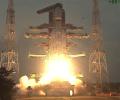
The heaviest communication satellite to be launched from the Indian soil onboard a new generation, homegrown 'Bahubali' rocket was successfully placed into the intended orbit on Sunday, the Indian Space Research Organisation said.

The EoI comes at a time when ISRO is working to enhance LVM3's payload capacity to five tonnes in GTO and is also evaluating the procurement of a Russian semi-cryogenic engine for the vehicle's second stage.

India's heaviest rocket ever is expected to take to the sky next January on an experimental flight whose later versions could be used to send humans on space missions.
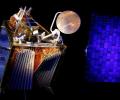
On Sunday, at 12.07 am in Sriharikota, off the coast of the Bay of Bengal, it was almost like an early Diwali, with the sky lit up by the launch of 36 OneWeb satellites. The Indian Space Research Organisation (Isro) did the launch on a 43.5-metre-tall Geosynchronous Satellite Launch Vehicle Mark III (GSLV Mk III) rocket. After the countdown, which started 24 hours in advance, once the mega screen marked the launch, a select group of invitees at the gallery cheered by applauding the feat.
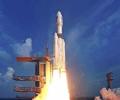
Taking its baby steps towards realising India's ambition to send humans into space, Indian Space Research Organisation on Thursday successfully tested the atmospheric re-entry of a crew module after its heaviest launch vehicle GSLV MK III blasted off from Sriharkota.
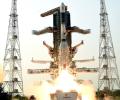
Over 32 missions -- satellites and rockets -- have been planned for the year.

The Indian space agency has already begun work on the third generation of the earth observation satellite -- the first of which will be ready by 2018 and boost the capability to generate digital maps.

GSLV Mark-III will be India's most powerful launch vehicle built to lift the heaviest Indian communications satellites to space.

The 3,423 kg GSAT-29 carries Ka and Ku band high throughput transponders intended to meet the communication requirements of users, including in the North East and in Jammu and Kashmir.
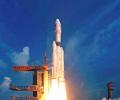
The rocket can put satellites weighing upto four tonnes in space, double the weight that the current GSLV-Mark-II can lift.

And the first Indian to go into space from 'Indian soil' could well be a woman.

Only three countries (United States, Russia and China) have successfully landed spacecraft on the airless lunar surface.

PSLV C-29 blasted off from the Satish Dhawan Space Centre, about 110 km from Chennai, at 6 pm and released the six satellites one by one into a 550 km circular orbit.

The 43.43 metre tall rocket lifted off at 5.28 pm from the second launch pad at the Satish Dhawan Space Centre in Sriharikota
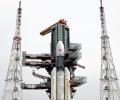
The Indian Space Research Organisation said that the countdown started at 6.51 am on Sunday.

A truly 'made in India' satellite that will empower a digital India.
Global analysts say a successful launch of operational GSLV MkII rocket will reduce dependency for ISRO on foreign launchers.

"I am extremely happy to announce that GSLV Mark III successfully injected Chandrayaan 2 in the defined orbit, infact the orbit is 6,000 km more than what was intended," Sivan said.

Dr Bhabha and Dr Sarabhai didn't feel guilty for their ambitions; it was for those 'mad scientists' that India is a powerhouse -- both at the atomic level and in the vastness of space, observes Kumar Abishek.
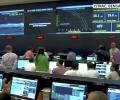
NASA said it is looking forward to explore the solar system with its Indian counterpart.

'India has got a unique opportunity to get more and more business from outside as India is cost-effective and reliable.'

An industrial house bred in old-school manufacturing values, Godrej & Boyce has displayed unusual agility to become a trusted builder of advanced weaponry, discovers Ajai Shukla.

Although Russia, United States and China have achieved a soft landing on the lunar surface, India is aiming at becoming the first one to explore the south pole of the Moon.

It has already tasted success with the moon mission and Mangalyaan. Is man in space the next frontier for ISRO?

Officials hint the visit could finally see a formal defence industrial road map being adopted by both nations.
ISRO chairman A S Kiran Kumar talks of what's on and what lies ahead for the Indian space agency.
